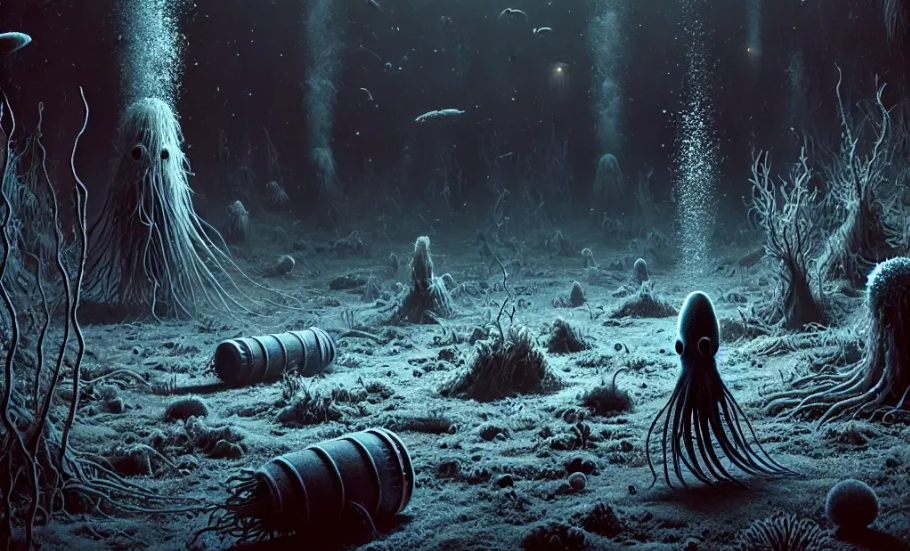
The deep sea is one of the least explored and most mysterious environments on Earth. In its dark, cold, and high-pressure depths, life has evolved in astonishing ways. One of the most fascinating phenomena is deep-sea gigantism—the tendency for some species to grow much larger than their shallow-water relatives.
From colossal squids to giant isopods, these enormous creatures challenge our understanding of biology and evolution. Studying them provides insights into how life adapts to extreme conditions and why size can sometimes be an advantage in the depths of the ocean.
What Is Deep-Sea Gigantism?
Deep-sea gigantism refers to the observation that many deep-water species are significantly larger than similar species in shallower environments. For example:
- Giant isopods, relatives of the common pill bug, can grow up to 2.5 feet long, compared to just a few inches for their shallow-water cousins.
- Colossal squids have been found measuring over 40 feet, far exceeding the size of most squids in coastal waters.
This trend occurs across a variety of species, including crustaceans, mollusks, and fish, and has fascinated scientists for decades.
Why Do Deep-Sea Creatures Grow So Large?
Several factors contribute to deep-sea gigantism:
- Cold Temperatures: Lower temperatures slow metabolism, allowing creatures to grow slowly over a longer lifespan.
- High Pressure: The deep-sea environment creates physiological conditions that support larger body structures.
- Scarce Food: Larger bodies can store energy and survive longer periods without food.
- Fewer Predators: Reduced predation in the deep sea allows species to grow bigger without being hunted.
While no single explanation fits all species, these factors combined help explain why many deep-sea creatures reach extraordinary sizes.
Examples of Deep-Sea Giants
- Giant Squid (Architeuthis dux): These elusive mollusks can reach lengths of 43 feet and have eyes as large as dinner plates, perfect for spotting prey in the darkness.
- Giant Isopod (Bathynomus giganteus): Scavengers of the deep, these crustaceans can weigh over 4 kilograms, slowly crawling along the ocean floor in search of food.
- Deep-Sea Spider Crab: Some species have leg spans of up to 12 feet, using their size to navigate sparse environments and protect themselves from predators.
These species are not only impressive in size but also adapted with unique behaviors to survive extreme conditions.
Adaptations That Support Gigantism
Living in the deep sea requires more than just large size. Deep-sea giants often display:
- Slow Metabolism: Conserves energy in an environment where meals may be rare.
- Efficient Oxygen Use: Adaptations allow them to survive in low-oxygen conditions.
- Enhanced Sensory Systems: Giant eyes, sensitive tentacles, or long antennae help detect prey and navigate in complete darkness.
These adaptations ensure survival in a habitat where light is absent, pressure is immense, and food is scarce.
The Mystique of the Deep Sea
The deep sea remains largely unexplored, and scientists continue to discover new species and behaviors. Gigantism is one of many mysteries that highlight how life adapts in extraordinary ways. It challenges our perceptions of normal size, evolution, and survival strategies.
Studying deep-sea giants also provides insights into biological processes, climate effects, and the history of ocean life, making the deep sea a crucial frontier for science.
Conclusion
Deep-sea gigantism is a fascinating example of how life evolves under extreme conditions. From colossal squids to giant isopods, these enormous creatures demonstrate the remarkable adaptability of life in the ocean’s darkest realms.
By exploring and understanding these giants, we gain not only scientific knowledge but also a sense of wonder about the natural world. The deep sea reminds us that Earth still holds secrets that continue to amaze and inspire curiosity.
In a world where the unseen can be larger than life, deep-sea giants invite us to look beyond the surface and marvel at the extraordinary.