Imagine walking along a dark beach at night and seeing the ocean suddenly glow with sparkling blue light, or discovering a tiny creature deep in the forest that shines like a living lantern. These magical scenes may sound like something from a fantasy story, but they are very real. They are created by bioluminescent organisms, living creatures capable of producing their own light.
Bioluminescence is one of nature’s most extraordinary phenomena. From the deepest parts of the ocean to quiet forests and caves, many organisms have evolved the ability to glow in the dark. Scientists estimate that over 75% of deep-sea creatures may possess some form of bioluminescence.
Understanding how and why these organisms produce light reveals a fascinating glimpse into the creativity of evolution.
What Is Bioluminescence?
Bioluminescence is the production of light by living organisms through a chemical reaction inside their bodies. This reaction usually involves two key components: a molecule called luciferin and an enzyme known as luciferase.
When these substances interact with oxygen, they create a reaction that releases energy in the form of light. Unlike artificial light sources, this process produces very little heat, making it highly efficient.
The colors of bioluminescent light vary depending on the organism. Many marine creatures produce blue or green light, while some insects emit yellow or green glows.
The Deep Sea: A World of Living Lights
The ocean depths are one of the most common habitats for bioluminescent creatures. In the deep sea, sunlight cannot reach, leaving the environment in near-complete darkness. In this dark world, light becomes a valuable tool for survival.
Many deep-sea animals use bioluminescence for communication, camouflage, or hunting.
For example, the anglerfish has a glowing lure that hangs in front of its mouth. This small light attracts curious prey, which the fish quickly captures once it gets close enough.
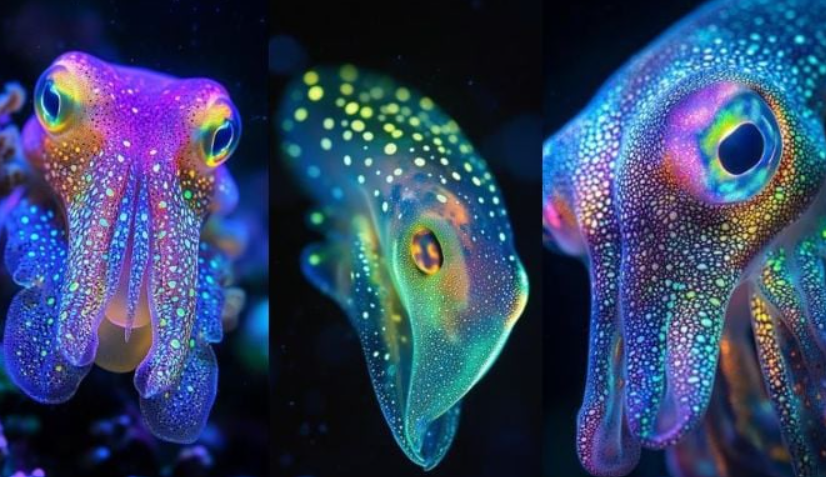
Other creatures, such as certain jellyfish and squid, can release glowing clouds of light to confuse predators and escape danger.
Fireflies: Nature’s Tiny Lanterns
One of the most familiar bioluminescent animals is the firefly, a small insect known for its glowing abdomen. Fireflies produce light to communicate with each other, particularly during mating season.
Each species of firefly has its own unique pattern of flashing lights. These signals help individuals recognize potential mates among thousands of other glowing insects in the night.
The warm glow of fireflies on summer evenings has inspired poetry, art, and wonder for generations.
Glowing Forests and Mushrooms
Bioluminescence is not limited to animals. Some fungi also possess the ability to glow in the dark. These glowing mushrooms, sometimes called “foxfire”, emit a soft green light that can be seen on decaying wood in forests.
Scientists believe that this glow may help attract insects, which then spread the mushroom’s spores to new locations.
Walking through a forest at night and encountering glowing fungi can feel like stepping into a mysterious and magical world.
Defense Through Light
For many organisms, bioluminescence serves as a defense mechanism. Some creatures suddenly flash bright light to startle predators, while others release glowing substances into the water to distract attackers.
One fascinating example is the vampire squid, a deep-sea creature that can produce glowing particles when threatened. These tiny lights float in the water, confusing predators and allowing the squid to escape.
In this way, light becomes a powerful survival strategy in dark environments.
Scientists and the Study of Bioluminescence
Bioluminescence has not only fascinated nature lovers but also inspired scientific discoveries. Researchers have studied glowing organisms to develop tools used in medicine and biotechnology.
For example, a glowing protein originally discovered in jellyfish has been used in laboratories to track cells and study diseases. This discovery has helped scientists better understand how certain illnesses develop and spread.
The study of bioluminescence continues to open new possibilities in scientific research.
Conclusion
Bioluminescent creatures reveal the remarkable creativity of life on Earth. From glowing jellyfish drifting through the ocean depths to fireflies lighting up summer nights, these organisms demonstrate how evolution can produce extraordinary adaptations.
Their glowing light is not only beautiful but also serves important purposes such as communication, defense, and survival in dark environments.
The next time you see a glowing insect or hear about mysterious lights in the ocean, remember that nature itself is capable of producing some of the most stunning displays of light imaginable.
In the hidden corners of our planet, entire worlds exist where living creatures illuminate the darkness.