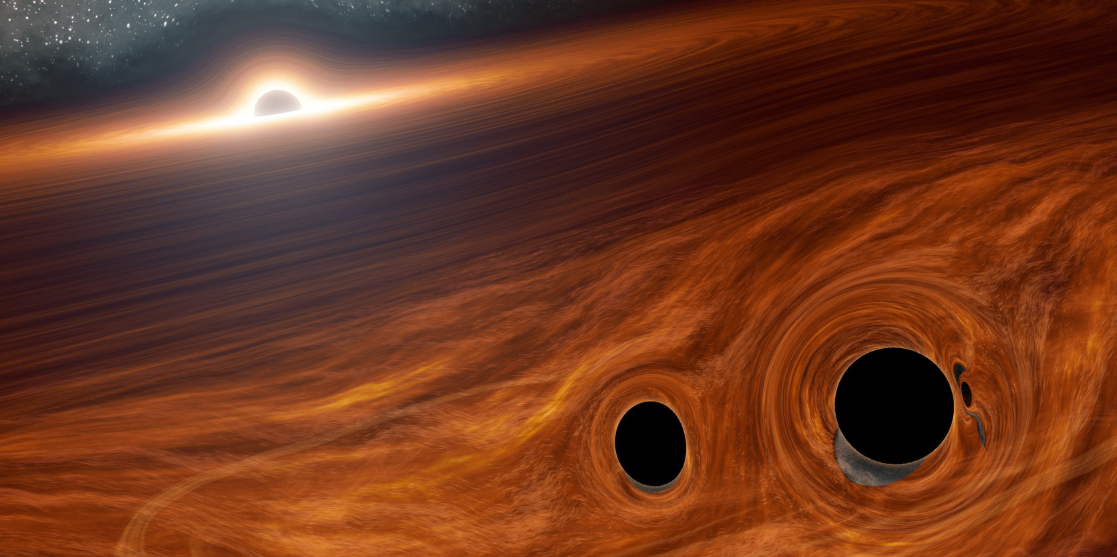
Black holes are some of the most enigmatic and awe-inspiring objects in the universe. They are regions of space where gravity is so intense that nothing, not even light, can escape. Despite being invisible, black holes reveal themselves through the effect they have on nearby matter and the emission of X-rays from heated gas.
From the smallest stellar black holes to the supermassive giants at the centers of galaxies, these cosmic phenomena challenge our understanding of physics, space, and time. Exploring black holes allows scientists to probe the extremes of the universe and even test the limits of Einstein’s theory of relativity.
How Black Holes Form
Most black holes are born from the collapse of massive stars. When a star much larger than the Sun exhausts its nuclear fuel, it can no longer support its own weight. The core collapses under gravity, compressing matter into a point of infinite density called a singularity.
Surrounding the singularity is the event horizon, the boundary beyond which nothing can escape. This makes black holes effectively invisible, detectable only through their interaction with surrounding matter.
Types of Black Holes
- Stellar Black Holes: Formed from dying massive stars, typically ranging from 5 to 50 times the mass of the Sun.
- Intermediate Black Holes: Mysterious mid-sized black holes, harder to detect, with hundreds to thousands of solar masses.
- Supermassive Black Holes: Found at the centers of galaxies, including the Milky Way. These giants have millions or billions of times the Sun’s mass.
Each type exhibits unique properties and plays a crucial role in shaping its cosmic neighborhood.
How We Detect Black Holes
Since black holes do not emit light, scientists detect them through indirect methods:
- Accretion Disks: Gas and dust falling into a black hole form a heated, glowing disk that emits X-rays.
- Gravitational Effects: Black holes bend the paths of nearby stars, revealing their presence.
- Gravitational Waves: Collisions between black holes produce ripples in spacetime, detectable by observatories like LIGO.
These methods have allowed astronomers to discover thousands of black holes in our galaxy and beyond.
The Strange Physics of Black Holes
Black holes are laboratories of extreme physics. Near a black hole:
- Time slows down: According to Einstein’s relativity, time moves slower near massive objects, meaning a person near a black hole experiences time differently than someone far away.
- Spaghettification: The immense gravitational gradient can stretch objects into thin strands as they approach the singularity.
- Event Horizon Mysteries: Information falling into a black hole may be lost or preserved in ways that challenge current physics theories, a problem known as the “information paradox.”
These phenomena push the boundaries of our understanding and inspire both scientists and science fiction writers alike.
Black Holes and the Universe
Black holes influence their surroundings in profound ways. Supermassive black holes, for example, regulate galaxy formation by controlling star birth through the release of energy and jets of particles. Even though they consume matter, black holes play a key role in maintaining cosmic balance.
Studying black holes helps scientists answer fundamental questions about the nature of gravity, spacetime, and the origin of the universe.
Conclusion
Black holes are more than cosmic curiosities—they are portals into the extremes of the universe, revealing the limits of physics and the mysteries of space and time. From stellar remnants to supermassive giants, these invisible titans challenge our imagination and scientific understanding.
By exploring black holes, humanity continues to push the boundaries of knowledge, seeking answers to questions that have fascinated us for centuries: What happens beyond the event horizon? Can information escape? How do black holes shape galaxies and the universe itself?
In contemplating black holes, we are reminded of the vastness, complexity, and wonder of the cosmos—a universe where space, time, and gravity collide in the most extraordinary ways.